Autumn Newsletter 2026
Published 30 Oct. 2026
Welcome to the Autumn Edition of Grand Challenge Insights!
In this blog, we will share the latest updates and highlights from our Grand Challenge community. Following MICCAI 2026, we look back at the challenges hosted on Grand Challenge and the contributions of our community during the conference.
💡 Challenge hosting Q&A session
Interested in benchmarking AI or inviting others to develop algorithms on your clinical data?
Come and sit in on our short presentation about hosting challenges on the Grand Challenge platform, followed by a Q&A. We'll talk about data, algorithm evaluation, communication, and cost considerations (approx. 30 min).
See you on Friday 13 November at 11:00 CET.
🔗 No sign-up needed: just join us via Microsoft Teams: https://teams.microsoft.com/meet/3791655485984283?p=hS0c2tgWdT1Bq6P3wo
🚀 MICCAI 2026
MICCAI 2026 is behind us, and we hope all challenge organisers had a successful workshop! One of our engineers was on site to meet the community and collect feedback from challenge organisers. We were happy to hear so much positive feedback, especially about our support team, and we will take the points of criticism on board as we keep improving the platform.
This year on Grand Challenge:
-
🏆 18 MICCAI challenges hosted
-
👥 4,433 registered participants
-
📊 3,646 solutions submitted
View all MICCAI challenges hosted on Grand Challenge.
We would like to thank all challenge organisers for their trust in our platform, and congratulate all participants on their excellent work and contributions to the field!
Are you a challenge organiser? You can share feedback through our survey. Inspired to host your own challenge? Get in touch at support@grand-challenge.org.
🔦 Highlighted MICCAI Challenges
🥅 Goal: Peripelvic fractures are among the most severe injuries, with high disability and mortality rates. PENGWIN 2026 aims to advance intelligent surgical planning in 3D CT, moving from "seeing" the fracture to planning its mechanical restoration. The dataset covers 500 clinical cases from seven institutions with expert annotations, plus 16,000 simulated fracture cases for training reduction models.
🏆 Winners:
| Task | 🥇 | 🥈 | 🥉 |
|---|---|---|---|
| Task 1: Automatic Segmentation | Team hb | Team SpaceCY | Team MIAGENT |
| Task 2: Interactive Segmentation | Team MIC | Team SpaceCY | Team MAGENTA |
| Task 3: Reduction Planning | Team OBL Lab | Team MIAGENT | Team IMIXR |

🥅 Goal: ODIN 2026, held with the Oral and Dental Image aNalysis workshop, benchmarks systems that turn routine oral and dental imaging into structured clinical text reports. Moving beyond earlier segmentation and landmark tasks, it evaluates end-to-end report generation, combining automatic metrics with blinded expert review of the top methods.
🏆 Winners:
| Task | 🥇 | 🥈 | 🥉 |
|---|---|---|---|
| Task 1: Maxillofacial and surgical report generation from CBCT | shivam.singh | ViktorB | Ryhn |
| Task 2: Orthodontic report generation from intraoral scans and photographs | lijingjing | yoonhaeo | aliishadman |
🛠 New features of Grand Challenge
Below you will find some highlights of the new features on our platform. For an extensive list, refer to the Cycle reports published at the end of every cycle.
If you have feature requests or suggestions for improvements, you can contact us at support@grand-challenge.org.
Mass Annotations in the Pathology Viewer
The client-side pathology viewer now supports over a million bounding boxes, lines, and polygons, in addition to point annotations, with real-time rendering, hover highlighting, label display, and two-way selection between the viewer and sidebar. Heavier calculations run in the background so the viewer won't experience any lag while working. For now, polygons are shown as outlines only.
Algorithm Templates, Endpoints & Batch Mode
The algorithm and evaluation method templates now use the new invoke API, making algorithms usable as interactive algorithms in reader studies and ready for batch mode in challenges. Read more about the new method here. Existing algorithms using the exec API will continue to work.
From November 2026 onward, challenges can run submissions in batch mode: your algorithm loads its model once and then runs multiple inference jobs within the same container, cutting costs and processing time for challenges with many small images. To enable batch mode for your challenge phases, contact support.
The REST API now also supports algorithm endpoints for external applications, made accessible through an updated GCAPI package.
Reader Study Improvements
In educational reader studies, answer scoring is now handled entirely by Grand Challenge. Note: clicking Verify now also saves the answer. The reader study panel also got a cleaner, consistent button layout, and you can now work through annotations without the mouse: Alt+Q/Alt+W step through all multiple-annotation questions, and the new Alt+G moves the viewer to the selected annotation. A new shortcut also accepts or rejects all pending algorithm findings in a case at once.
💡 Developer Blog posts
"July 2026 Cycle Report"
Read all about the platform improvements from our RSE team in July.
"September 2026 Cycle Report"
Read all about the platform improvements from our RSE team in September.
"October 2026 Cycle Report"
Read all about the platform improvements from our RSE team in October.
🔦 Highlighted Algorithms
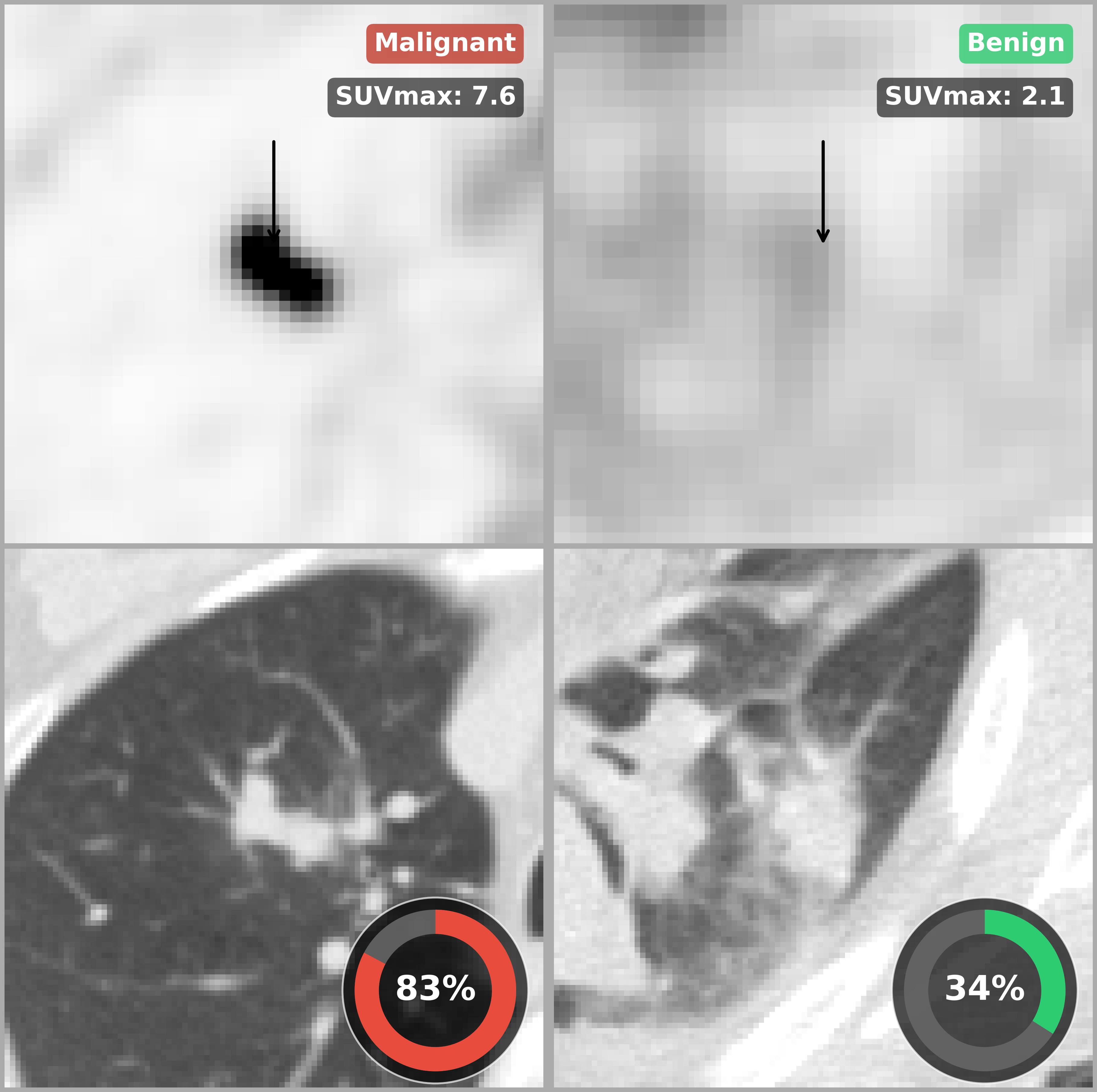
Pulmonary Nodule Malignancy Prediction on PET/CT (AITO-PETCT-MP)
This algorithm estimates the malignancy risk of pulmonary nodules from combined PET/CT imaging. Given a CT scan, a PET scan in SUV, and the location of each nodule, it returns a calibrated malignancy probability between 0 and 1 per nodule. The model is an ensemble of five 3D ResNet-18 networks that take a two-channel PET and CT patch centred on each nodule, trained on PET/CT data from Radboudumc. It reached an AUC of 0.78, compared with 0.73 for the Herder model and 0.80 for expert clinicians.